Announcing the ReelLife Science Special Guest Judges

Ciara Judge, Sophie Healy-Thow and Emer Hickey. Photo credit: Irish Times

ReelLife Science are delighted to announce that our Special Guest Judges for 2013 are the three Young Scientists from Kinsale in Co. Cork, who won first prize at this year’s BT Young Scientist and Technology Exhibition and then went on to scoop the top Biology prize at the European Union Contest for Young Scientists in Prague two weeks ago.

The three Young Scientists proved that the use of Nitrogen-fixing bacteria can significantly accelerate barley seed germination rates, which has huge potential to improve the yield of valuable crops. The results are based on the analysis of the performance of over 5,290 seed samples in 105 experimental runs over a 6 month period.

Emer and Sophie appeared on yesterday’s RTE “elev8” programme speaking about their award-winning research (skip to 15 mins).

We are honoured to have the three girls as part of our team, along with our other Expert Judges, Professor Andrea Brand of the Gurdon Institute in Cambridge and Professor Rhodri Ceredig of the Regenerative Medicine Institute (REMEDI) in NUI Galway.

Prof. Andrea Brand, Gurdon Institute, Cambridge

Prof. Brand’s research focuses on understanding how stem cells specialise to become part of our nervous systems, e.g. neurons, with the goal of repairing or regenerating damaged neurons in the brain or spinal cord. The Gurdon Institute was named after Prof. John Gurdon, who shared last year’s Nobel Prize for Physiology or Medicine “for the discovery that mature cells can be reprogrammed to become pluripotent.” This work has led to the development of the field of iPSCs, or Induced Pluripotent Stem Cells, where non-stem cells can be reprogrammed to become stem cells, and in turn, different types of cells from around the body.
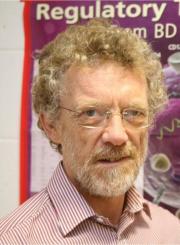
Prof. Rhodri Ceredig, REMEDI, NUI Galway

Prof. Rhodri Ceredig also works with Stem Cells, and is particularly interested in their role in the Immune System, work which is carried out in the Regenerative Medicine Institute (REMEDI) in NUI Galway. REMEDI’s main focus is using Stem Cells to promote organ and tissue repair and regeneration, in the areas of cardiovascular disease, diabetes mellitus and osteoarthritis. Prof. Ceredig has a particular interest in Flow Cytometry, which is a powerful technique used to count and separate cells into different populations. Check out the Irish Cytometry Society for more information.

We are delighted to have these eminent scientists as part of our ReelLife Science Team!

OUR BODIES: “Separating fact from fiction” by Marie Carkill

In the second of our articles written by Biotechnology undergraduate ReelLife Science team members, Marie Carkill answers some questions about Our Bodies:

There are a multitude of features often overlooked or unnoticed about the human body, which when examined, can prove fascinating. Separating fact from fiction when it comes to the science of our bodies, can sometimes go against what we had always believed to be true.

Let’s ask some “why” questions that few people really take the time to think about, just take for granted; no questions asked. It’s the scientific answers to the day-to-day questions that really ignite the inquisitive flame within us!

Why does hair turn grey?

Chelsea FC Manager Jose Mourinho. Photo Credit: Tsutomu Takasu

At the base of each hair follicle, pigment cells are located which produce a chemical called melanin. As hair grows, the pigment cells produce the natural dominant colour (brown, blonde etc.). But as we get older, the pigment cells begin to die and as the hair grows it will no longer contain as much melanin. Colour is lost from individual hairs one by one until eventually, hair looks completely grey or white.

Why, when nervous do we get a dry throat and “butterflies in the stomach”?

When we are in a tense or dangerous situation, the renowned “fight or flight” reaction comes into play. The body shuts down any unnecessary functions, including the digestive system, in order to utilise all its energy on the most important organs (heart, muscles) to making a quick getaway.

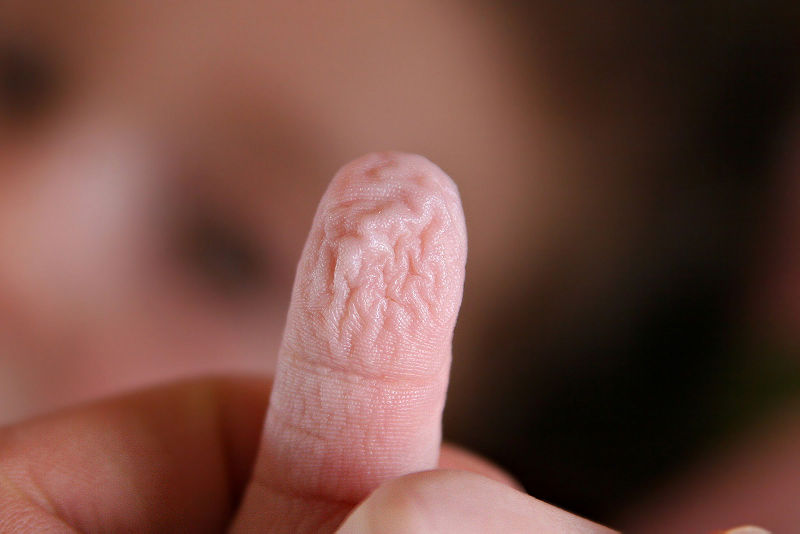
Why does skin wrinkle after prolonged immersion in water?

Water-immersion wrinkling. Photo credit: Fir0002/Flagstaffotos

Our whole body is covered in a protective waterproof layer of keratin, but on our fingers and toes this layer is continuously worn away. When we take a bath or go swimming the thick and tough layer of “exposed” skin begins to absorb water by osmosis and expand, causing the skin to buckle.

Why does garlic give you bad breath?

Garlic owes its pungency to a potent antifungal and antibacterial compound called allicin which can produce a multitude of sulphur-containing compounds, produced after cutting the clove. After eating some garlic, allicin and its products enter the digestive system, and later into the bloodstream and can only leave the body again by means of exhalation or perspiration. This is why the effects of eating garlic could prolong until the morning after a meal! Even just rubbing garlic on the skin can be enough to conjure smelly breath, as it exits the body though sweat or via the lungs.

Why do our knuckles make a cracking noise?

Cracking knuckles (photo credit: Orijinal)
Cracking knuckles. Photo credit: Orijinal

When the joint is stressed, bubbles of nitrogen gas form within the synovial fluid. When the pressure changes, the bubbles collapse creating the “cracking” sound in the joint. Despite several theories, there is little evidence to suggest that knuckle cracking causes arthritis. One American doctor even went to the extremes of spending 50 years cracking the knuckles on just one hand to see if there was a difference – there wasn’t.

Why do fingernails and hair grow after death?

This is myth, hair and fingernails do not grow after death. Instead, the surrounding tissues dry out as the bodies dehydrate. The skin tightens and shrinks away from the nail folds and hair shafts, creating the illusion of growth.

Marie Carkill

HABITATS: “Life on the Edge in the Polar North” by Alex Corrigan

In a new feature, our Biotechnology undergraduate team members have each chosen one of the ReelLife Science topics, and researched and written a short article. We hope you enjoy them, learn a little from them and perhaps get some inspiration for your videos! First up is Alex Corrigan with “Life on the Edge in the Polar North”.

(photo by Max Edin National Geographic)

Svalbard is an archipelago of three main islands, Spitsbergen, Nordaustlandet and Edegøya in the Arctic Ocean far to the North of mainland Norway. These beautiful but isolated islands are sparsely populated by humans, but are home to a wide variety of specialised animals who eke out a living in the harsh polar climate of the Arctic Circle.

(photo from svalbard.travelize.se)

The islands of Svalbard encompass a landscape of high mountain ranges, deep valleys and fjords, with glaciers and ice-flows, which cover up to 60% of the terrain. The archipelago is under the grip of the harsh Arctic Climate , with its midnight sun and total darkness in the winter months. Average winter temperatures can dip as low as -18°C with summers only reaching a frosty 2-4°C.

It’s hard to imagine life flourishing in these conditions, yet it does. Svalbard is a breeding ground for many species of seabirds and also hosts larger creatures such as reindeer, Arctic foxes, polar bears and marine mammals such as walruses and seals. There are no less than seven national parks in Svalbard to protect the largely untouched, yet fragile, ecosystems and habitats. Continue reading “HABITATS: “Life on the Edge in the Polar North” by Alex Corrigan”