Here you will find the 2014 ReelLIFE SCIENCE Primary and Secondary school video topics. Teachers and students can select a topic and decide what they are going to focus on for their particular 3 minute video. Check out our Teachers’ Tips page for advice on preparing, making and submitting your video online before the October 17th deadline.
This year, to give you more information about the different topics and perhaps give you some ideas for your video, we’re delighted to be able to showcase some of the best scientific research being carried out in NUI Galway, via a weekly series of articles by the researchers themselves.
In the second of our articles written by Biotechnology undergraduate ReelLife Science team members, Marie Carkill answers some questions about Our Bodies:
There are a multitude of features often overlooked or unnoticed about the human body, which when examined, can prove fascinating. Separating fact from fiction when it comes to the science of our bodies, can sometimes go against what we had always believed to be true.
Let’s ask some “why” questions that few people really take the time to think about, just take for granted; no questions asked. It’s the scientific answers to the day-to-day questions that really ignite the inquisitive flame within us!
Why does hair turn grey?
Chelsea FC Manager Jose Mourinho. Photo Credit: Tsutomu Takasu
At the base of each hair follicle, pigment cells are located which produce a chemical called melanin. As hair grows, the pigment cells produce the natural dominant colour (brown, blonde etc.). But as we get older, the pigment cells begin to die and as the hair grows it will no longer contain as much melanin. Colour is lost from individual hairs one by one until eventually, hair looks completely grey or white.
Why, when nervous do we get a dry throat and “butterflies in the stomach”?
When we are in a tense or dangerous situation, the renowned “fight or flight” reaction comes into play. The body shuts down any unnecessary functions, including the digestive system, in order to utilise all its energy on the most important organs (heart, muscles) to making a quick getaway.
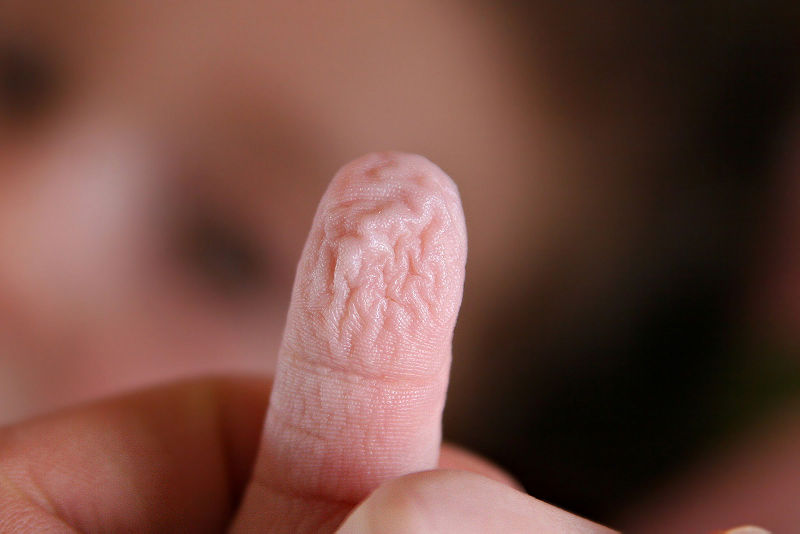
Why does skin wrinkle after prolonged immersion in water?
Our whole body is covered in a protective waterproof layer of keratin, but on our fingers and toes this layer is continuously worn away. When we take a bath or go swimming the thick and tough layer of “exposed” skin begins to absorb water by osmosis and expand, causing the skin to buckle.
Why does garlic give you bad breath?
Garlic owes its pungency to a potent antifungal and antibacterial compound called allicin which can produce a multitude of sulphur-containing compounds, produced after cutting the clove. After eating some garlic, allicin and its products enter the digestive system, and later into the bloodstream and can only leave the body again by means of exhalation or perspiration. This is why the effects of eating garlic could prolong until the morning after a meal! Even just rubbing garlic on the skin can be enough to conjure smelly breath, as it exits the body though sweat or via the lungs.
Why do our knuckles make a cracking noise?
Cracking knuckles. Photo credit: Orijinal
When the joint is stressed, bubbles of nitrogen gas form within the synovial fluid. When the pressure changes, the bubbles collapse creating the “cracking” sound in the joint. Despite several theories, there is little evidence to suggest that knuckle cracking causes arthritis. One American doctor even went to the extremes of spending 50 years cracking the knuckles on just one hand to see if there was a difference – there wasn’t.
Why do fingernails and hair grow after death?
This is myth, hair and fingernails do not grow after death. Instead, the surrounding tissues dry out as the bodies dehydrate. The skin tightens and shrinks away from the nail folds and hair shafts, creating the illusion of growth.
Stem cells are very special, unspecialised cells that can become, and replace, any type of cell in our body. We need stem cells to replenish the millions of blood, skin and other types of cells that die every day.
Medically, surgeons use layers of skin derived from stem cells to treat extensively burned tissue, while stem cells can be differentiated into heart, brain and other tissue types for potential new therapies. In the lab, stem cells are also used to test new drugs and give insights into complex conditions like Alzheimer’s, Parkinsons’s and diabetes.
This beautifully produced short film by EuroStemCell gives an introduction into the life of stem cells inside and outside our body.




 ReelLIFE SCIENCE