HABITATS: Atlas of Ireland’s Marine Mammals

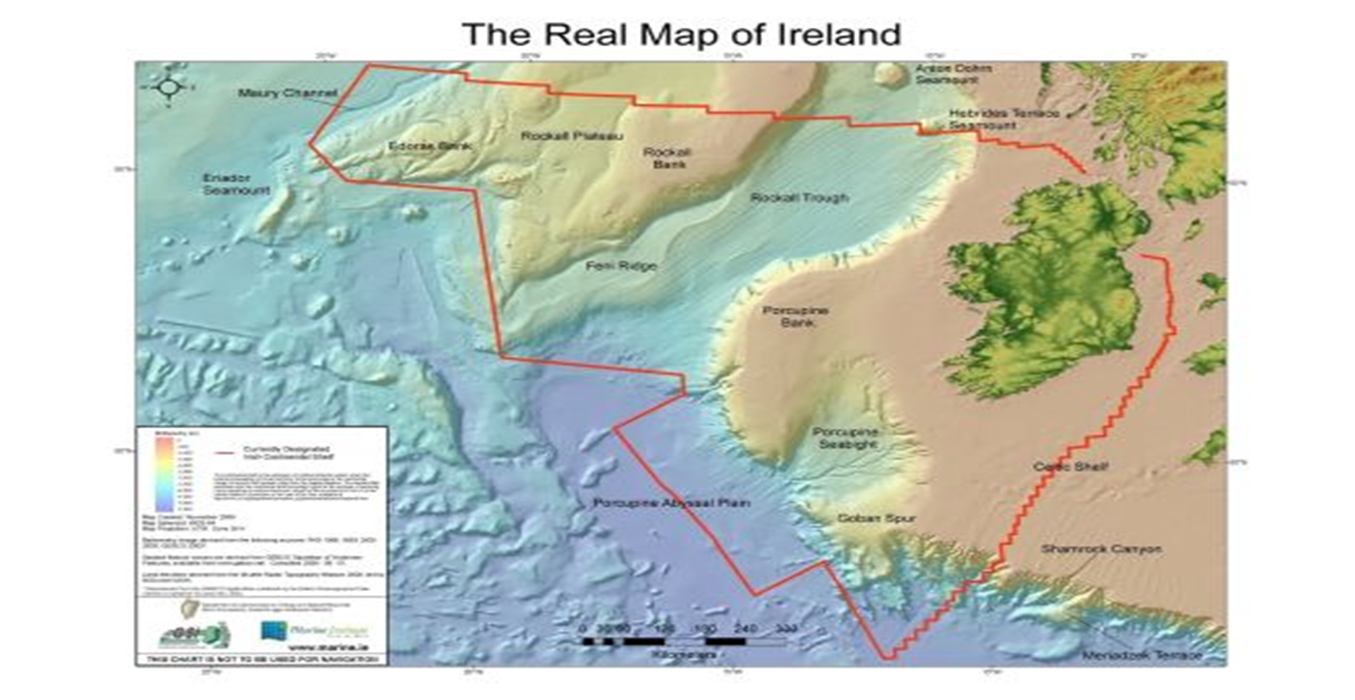
The Real Map of Ireland

Image courtesy of the Marine Institute

Last week the Irish Whale and Dolphin Group published their Offshore Marine Mammal Atlas, which surveyed Ireland’s seas for whales, dolphins and seals. The Atlas took six years to complete, with researchers spending over 1,000 days at sea recording more than 3,300 sightings of 35,000 animals.

As you can see from the image above, Ireland’s seabed territory extends far into the Atlantic Ocean, but also contains part of the Irish and Celtic Sea, and taken together is called the “Irish Continental Shelf”. The island of Ireland covers 20,863,360 acres of land but can claim a marine and undersea territory over ten times greater than that, at a staggering 220 million acres. The UN Convention of the Law of the Sea grants Ireland the sovereign right to explore this area and to exploit its natural resources.

Celtic Explorer

Image courtesy of the Marine Institute

The marine mammal survey took over 5,000 hours of survey effort and was carried out on a variety of vessels, including research vessels (e.g. R.V. Celtic Explorer above), naval vessels (e.g. LE Roisin) and even car ferries (e.g. MV Ulysses). Researchers searched the seas ahead of the vessel by eye and using binoculars, typically on the deck but also on the “monkey island” (i.e. on the roof of the bridge) and the “crow’s nest”. Weather conditions and position data were automatically collected by the ship’s onboard computers and GPS. Continue reading “HABITATS: Atlas of Ireland’s Marine Mammals”

EVOLUTION: Jurassic Park meets Ice Age

With the effects of global warming revealing more and more well-preserved Mammoth remains under the Siberian permafrost, the possibility of cloning a Mammoth seems closer than ever.

At least one team of scientists are analysing Mammoth tissue samples for whole cells with intact nuclei, to provide sufficient DNA needed to clone this extinct species. This procedure would be similar to that famously used to clone Dolly the sheep the first cloned mammal.

Crucially, though, there is an abundant supply of sheep living in Scotland to provide calls and surrogate mothers to whereas the mammoth has been extinct for about 4,000 years. DNA degrades over time, even in perfect lab conditions, so finding a completely intact genome (a species’ entire DNA sequence) is extremely unlikely. However, gaps in one individual’s genome could be patched up with sequence from another’s partial sequence, however this would be a painstaking and probably error-ridden process.

The Mammoth’s closest living relative is the Asian elephant, which could be used to attempt to produce a viable embryo with the patched-up Mammoth DNA and bring the baby Mammoth to term, probably around 2 years later, which is an elephant’s typical gestation period.

The ethical questions surrounding this type of “de-extinction” cloning, focuses on the effort and resources needed to bring an extinct species back, when so many extant species are already on the brink of extinction, and the possibility that this technology could be used to bring back other human species, such as Neanderthals.

More information can be found in the recent National Geographic “Reviving Extinct Species” special.


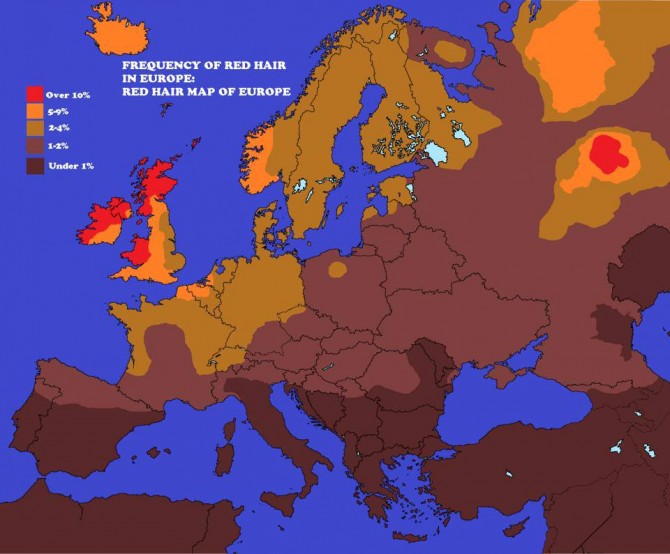
OUR BODIES: The origins and distribution of Red Hair.

RedHairEurope-670x554

Picture courtesy Prof. James McInerney

With temperatures soaring this week, it’s definitely time to slap on the sunscreen, particularly for those with fairer skin and red hair. But where does red hair come from, what is its genetic basis and where is it most common?

Most people with red hair have two recessive alleles (alleles are different forms of the same genes inherited from your parents) for the gene coding for the MC1R protein. These ‘homozygous recessive’ individuals produce a higher level of the yellow-reddish phaeomelanin pigment to those with two dominant alleles (homozygous dominant) or one dominant and one recessive (heterozygous), where the brown-black eumelanin is more prominent. Continue reading “OUR BODIES: The origins and distribution of Red Hair.”